
Swaps
Company: Flexcar
Role: Senior Product Designer (Lead on experience & design strategy)
Scope: End-to-end product design, product strategy
Team: Product, Engineering, Data Science, BI
Platform: iOS, Android
Impact: $1.6M net new profit, 2K new swaps made
Challenge
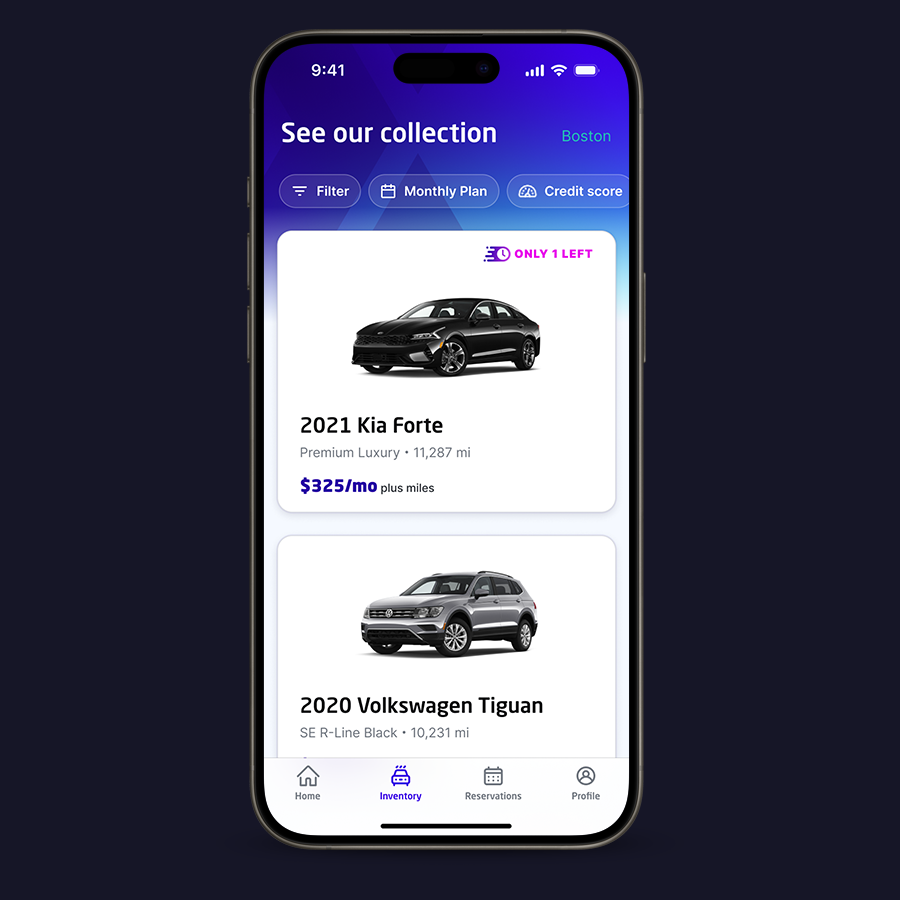
Flexcar, a car subscription service, was on a trajectory to lose $8M by June, and leadership needed a way to grow revenue without sacrificing customer satisfaction. The majority of Flexcar's vehicles were used as second cars, with a disproportionately high concentration of grad-student users in the Northeast — a segment sensitive to reliability and price, and quick to churn if the service failed them even once.
Task
I was tasked with identifying why customers were abandoning their subscriptions and designing a solution that could protect revenue, keep cars on the road, and raise CSAT. This meant going beyond dashboards to find ground-truth insight into what was actually happening at the lot level.
Approach
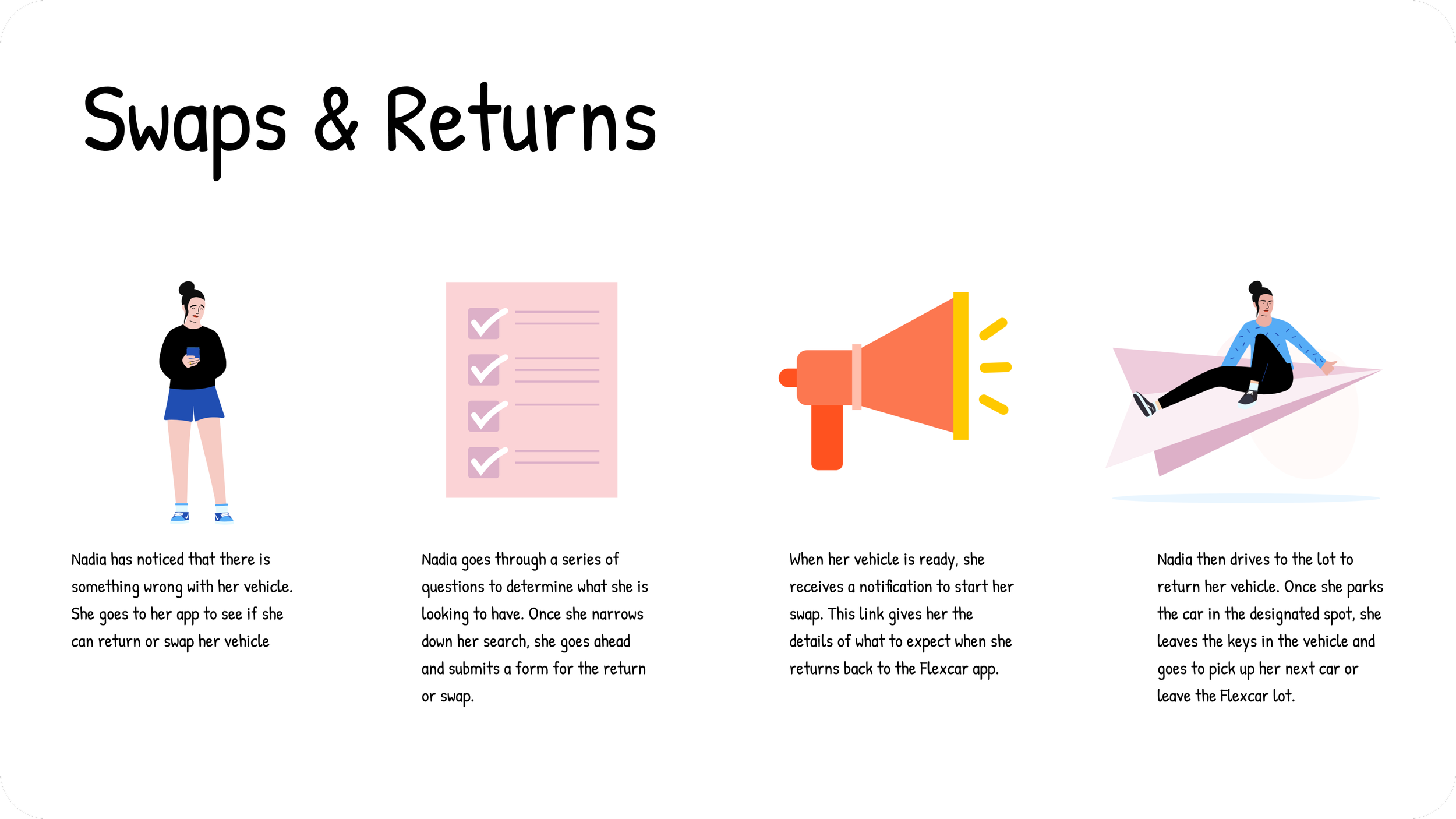
I visited four Flexcar locations—Atlanta, Boston, Charlotte, and Auburn, MA) to run in-person customer surveys and interview lot associates directly. This research surfaced a critical, previously invisible cost driver: customers were frequently returning malfunctioning vehicles, taking an Uber to their destination, and canceling their subscription outright while the returned car sat idle, costing Flexcar $149/day.
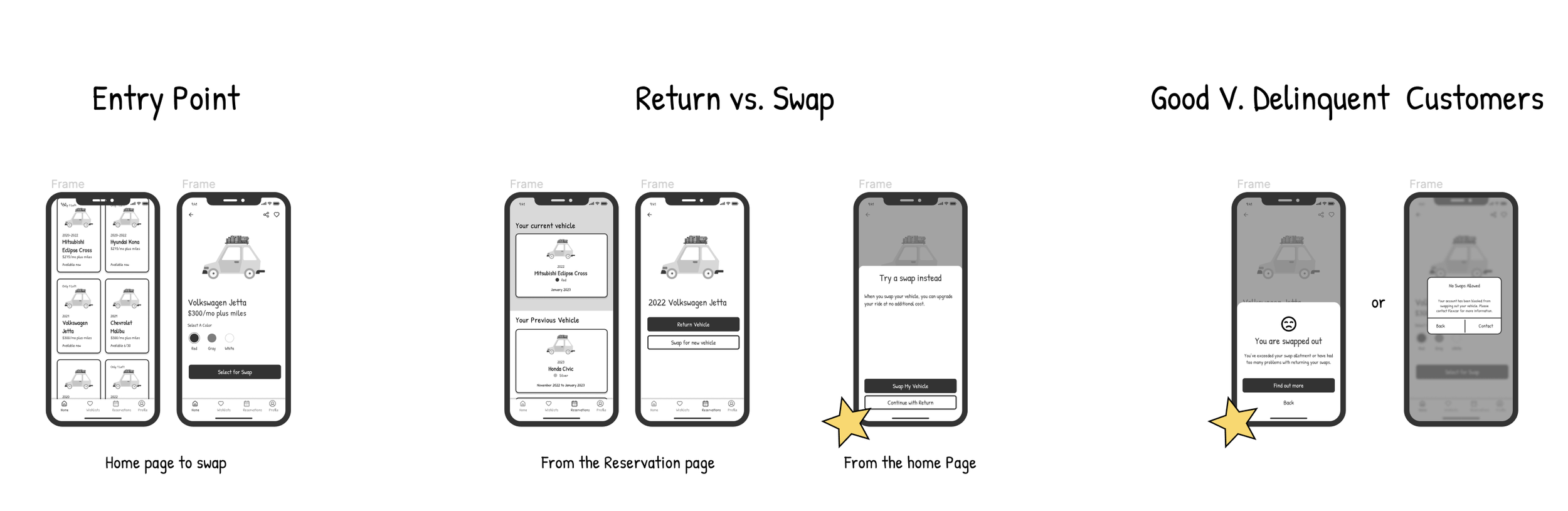
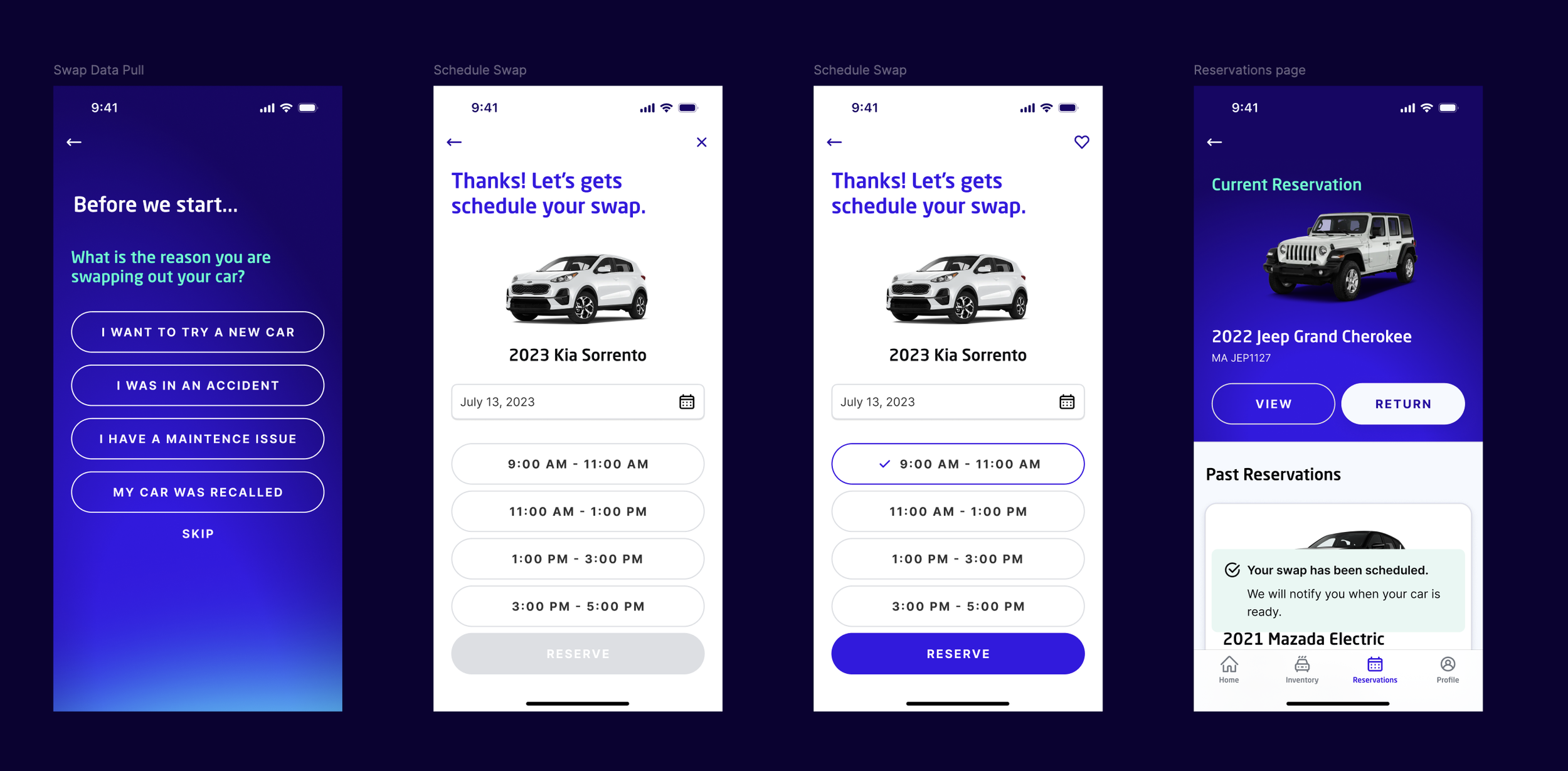
From there, I designed Swaps, letting eligible customers exchange their car for another in-service vehicle instead of canceling. I defined four eligibility criteria (active recall, major maintenance flaw, month-to-month renewal window, or high-credit "swap for fun" customers) and built a credit-rating matrix to gate eligibility. When scoping the MVP, I made the call to cut the "swap for fun" criterion and push it to Phase 2 — a live Ford Explorer recall made it clear that fixing safety and maintenance-driven cancellations was the higher-leverage problem to solve first, and directly tied to the CSAT goal in a way the "for fun" case didn't. I mapped the end-to-end customer journey with edge cases to prevent feature abuse, delivered the MVP visual design, and laid out the roadmap for Phase 2 and 3.
Results
Swaps launched in Auburn, MA in May 2023 and generated $1.6M in revenue within the first month. By July, momentum had scaled to over 2k swaped vehicles. The feature also delivered an 8.3% net profit lift and a 2-point CSAT increase which turned a revenue-leaking cancellation moment into a retention and profit driver.
Takeaways
This project reinforced that the best product opportunities often live outside the dashboard — the $149/day carrying cost and the cancellation pattern only surfaced because I went to the lots and talked to associates directly. It also sharpened how I scope MVPs under pressure: cutting "swap for fun" wasn't a compromise, it was the decision that kept the feature tied to the actual CSAT problem instead of a nice-to-have.